WOMBATS OF AUSTRALIA
The Wombat - Vombatus ursinus - Meaning bear-like wombat.
There are three species of wombats in the Vombatidae family:
The Northern Hairy nosed Wombat also known as the Yaminon is one of the rarest mammals in the world and is now considered to be critically endangered. Largest of the three wombats, the Northern Hairy-nosed Wombat can weigh up to 40kg and be more than 1 metre long. It’s physique is strong and heavily built with short, stubby but powerful legs and strong claws. It has a broad head with black patches around it’s eyes. The female is a little bit bigger than the male because they have an extra layer of fat. The Northern Hairy-nosed Wombat is unique in that it is able to breed faster than the common wombat, being able to produce 2 young every 3 years. They tend to give birth to a young during the wet season which is around November to April. Compared to the Common Wombat the northern Hairy-nosed wombat has softer fur, their ears are longer and slightly pointed with tufts of white hair on the edges and they have a broader muzzle fringed with fine, short, brown hairs called whiskers. Their noses are very important for their daily survival because they have very poor eyesight. They mainly rely on their sense of smell. They are shy animal, that's why most of the time they are solitary and only go out during night time, but there are times and instances when they share burrows with other wombats. The Northern-hairy nosed Wombat previously lived in three States of Australia:
Sadly, it is extinct naturally, except in one park which has semi-arid woodland and grassland on sandy soil - the Epping Forest National Park along the Belyando river system which runs through the park. (The park is about 200 km north-east of Barcaldine in Central Queensland) their range covers a 300ha of 3160ha - less than one tenth of the park. Current population of the Northern Hairy-nosed Wombat is estimated at only 90 animals, all individuals alive today are known to eventuate from a single location. Only 25 breeding females are believed to exist. A Second Population On the 27 November 2008, 12 Northern hairy-nosed Wombats were transported to a privately owned Nature Refuge (Richard Underwood Nature refuge). Ed and Gabi Underwood – the owners of Yarran Downs entered in a nature refuge agreement over the part of their property where the wombats have been reintroduced, about 105 hectares of eucalypt woodland on old river levees. As of March 2011, there are 11 Northern Hairy-nosed Wombats at Richard Underwood Nature Refuge - Four joeys have since been born at the refuge since established in 2009 – all joey’s are still in mother’s pouches. Follow their progress in the Wombat Diaries – http://www.derm.qld.gov.au/wildlife-ecosystems/wildlife/threatened_plants_and_animals/endangered/northern_hairynosed_wombat/wombat-diary.html How Volunteers can help? In the years 2000 and 2001, Dingoes eliminated 10 adults (10% of the population) and so in 2002 a 20-klm-predator-fence (dingo-proof-fence) was built and encompasses all wombat habitat in Epping Forest National Park. The Northern-hairy nosed wombat competes for food with the Eastern Grey Kangaroo, feed and water stations are now being used by wombats, particularly in dry times. A volunteer caretaker program ensures twice daily monitoring of the dingo fence. Three censuses each year minimize disturbance and maximize the accuracy of the result and involve collecting wombat hair on sticky tape to extract DNA. There are no Northern-hairy nosed wombats in captivity. |

Download a PDF or View Online - click the picture




Advertise for ONLY $2.50 per month
|
|
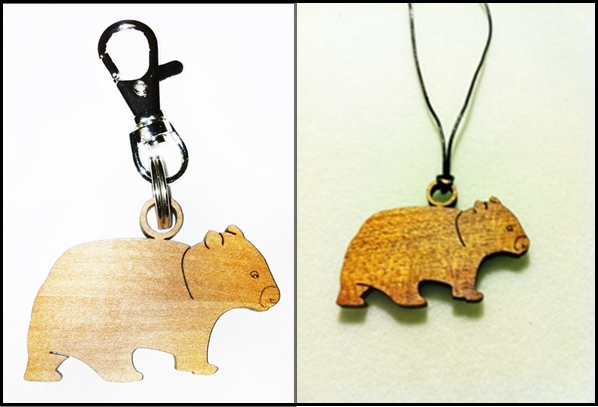
Beautiful 100% Recycled Tasmanian Timber Keyring
Beautiful 100% recycled Tasmanian timber pendant
|
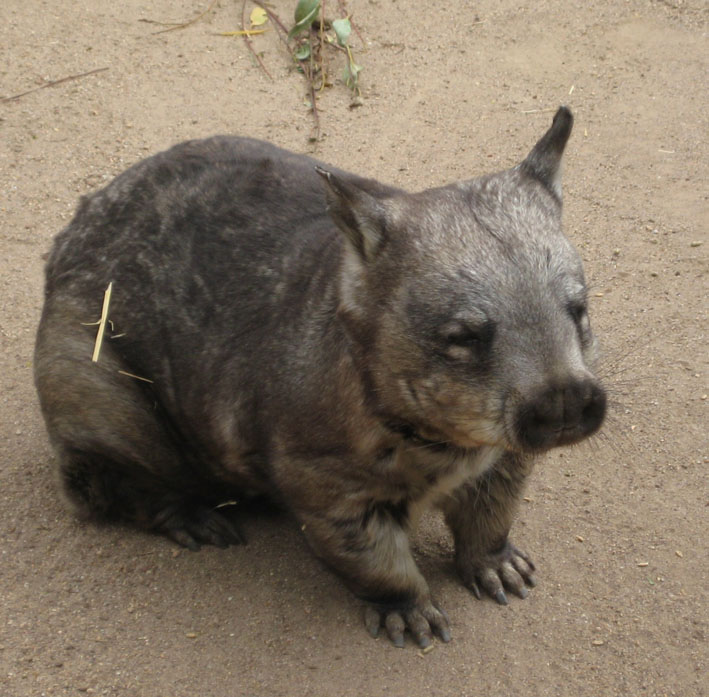
The Southern Hairy- nosed Wombat is endemic to Australia, where it is largely distributed in Southern South Australia, west of the Murray River, and patchily distributed on the York Peninsula and Eyre Peninsula; also present across the Nullarbor Plain into Western Australia. There are two known colonies in New South Wales.
It is abundant on the Nullarbor Plain, where there are estimates of between 50,000 and 100,000 in the South Australia portion. There are no population estimates for the Western Australia portion of the Nullarbor Plain. Throughout South Australia there is believed to be a solid population. In the Murray Lands, there seem to be 10,000 – 15,000 individuals, but the population has declined by 70% since 2002, probably due to sarcoptic mange and drought. The Gawler Ranges - SA hold about 10,000 individuals(but this estimate is about 25 years old). Elliston(SA) holds approximately 3,000 individuals. Kellidie Bay Conservation Park(SA) contains about 100, Wedge Island has about 100 (introduced), there are about 100-1,000 estimated in Lake Everard(The Range – SA). York and Eyre Peninsulas in SA have small populations throughout the area. In Remnant York Peninsula populations include: Wool Bay(SA) with about 100 individuals, Port Victoria(SA) has about 400, Urania(SA) has about 200 and there are about 50-100 within the small area of Kadina(SA).
The Southern hairy-nosed Wombat is threatened by competition for grazing by domestic stock and introduced rabbits. Sarcoptic Mange is now a major threat in the Murray Lands to the east; it kills 80-90 percent of affected populations/groups. Drought is another threat, especially for successful reproduction (In drought years reproduction may cease and three consecutive years of ample rainfall are needed for there to be an increase in a population.)
Animals live in colonies within extensive burrow systems. Each warren contains several animals. The species is long lived (living more than 15 years in the wild)
The Southern Hairy-Nosed Wombat weighs between 19 - 38kg and is up to
approximately 0.9 metres in length. It lives for approximately 14 to 15 years in the wild.
The Bare Nosed Wombat
also called the common wombat
Wombats are grazing marsupials, and are among the world’s largest herbivorous burrowers known as the hobbits of the Australian bush, they are considered as one of the most mysterious of Australia’s marsupials as much of their lives are spent underground in their burrows (up to 16 hours daily).
Wombats appear to be slow and cumbersome creatures that plod along while grazing their favourite harsh native grasses. However, they can reach
lightening speed if needed and have been known to reach speeds of up to 40 kilometres per hour - they can hold this speed for approximately 150 metres. (Only a handful of men can hold 36 kilometres per hour over a 100 metre distance.)
There are three subspecies of the common wombat:
Vombatus ursinus ursinus (Flinders Island wombat subspecies only found on Flinders Island).
Vombatus ursinus hirsutus (Mainland bare-nosed or common wombat subspecies).
Vombatus ursinus tasmaniensis (Tasmanian wombat subspecies).
The Bare-Nosed Wombat Vombatus ursinus hirsutus is located in the south-eastern areas of the mainland within the states of New South Wales, Victoria and in a tiny area at the very south-eastern corner of Queensland and in the south-eastern corner of South Australia.
Subspecies Vombatus ursinus ursinus can be found on Flinders Island.
Subspecies Vombatus ursinus tasmaniensis is located only within Tasmania.
Their robust build, blunt head, short limbs and strong spade-like claws make them powerful earth-movers.
The main habitat for the Bare-nosed Wombat is forest covered and often in mountainous areas that are suitable for burrowing. There must be access to clearings with native grasses for grazing. It requires a temperate, humid micro-environment.
In New South Wales and Queensland the Bare-Nosed Wombat occurs mainly in sclerophyll forests, however with increased logging and farming activity wombats can also be found living in pine plantations and grazing land.
In South Australia and Tasmania the Bare-nosed Wombat can be found in more open vegetation including coastal scrub, woodlands and heath lands.
The Bare-Nosed Wombat feeds mainly on native grass, herbivorous plants and the roots and bulbs of shrubs or trees. It also eats bark from native trees and a considerable amount of dirt.
Favoured native grasses include kangaroo grass, tussock, wallaby grass and spear grass.
Introduced grasses are also eaten.
The Bare-Nosed Wombat is a herbivore.
The Bare-Nosed Wombat is essentially solitary, however home ranges do overlap and burrows can often be shared, although rarely simultaneously.
Bare-Nosed Wombats are known to aggressively defend their territory against intruding wombats.
A Bare-Nosed Wombat joey is an endearing animal. Because of the strong bond an orphaned joey will have with its “human mum” many people wrongfully believe that a wombat would make an ideal pet. However, Bare-Nosed Wombats are particularly destructive animals and most have strong and wilful characters. While the joey is young this behaviour can seem cute and is easy to handle in such a small bundle, however when the wombat grows the stubborn streak and aggressive nature tends to grow with it and it can become nearly impossible to handle!
Adult wombats are very aggressive and will not hesitate to attack an intruder if they feel that they are threatened. Signs of an angry wombat that may be ready for attack are loud vocalisations (screams), teeth gnashing and ears down. If you meet a wombat in this state – run very fast in the other direction!
The wombat has short stumpy looking legs and small paws with fleshy pads.
It is classified as a “plantigrade” which is an animal that walks on the whole surface of their feet. Their flat footed soles are very much suited to the normal activities of standing around eating grass or digging.
Wombats rarely reach high speeds so don’t have the high balled foot pads such as canines. The front paws look similar to a dog’s paw but are quite broader; ideal for digging. The hind paws are longer and built to shovel dirt away as the front paws dig.
The skeleton of an adult Bare-Nosed Wombat supports a weight of approximately 22-50 kilograms, the average being around 26kg. Length is approximately 900-1150 metres.
A unique feature of the wombat’s skeletal system is the hard plate that covers its rump area. The plate’s function is solely for protecting the wombat from attack. In such situations, the wombat will enter its burrow, or an area where it can protect most of its body (eg: rock crevice) leaving the rump exposed.
The hard surface protects the animal from serious injury. The wombat also uses the plate to slam its opponent against the top of the burrow.
The Bare-Nosed Wombat has one set of upper and lower incisors that form the cutting edge. The lower incisors are forward pointing with chisel shaped ends.
There is one set of pre-molars top and bottom and four sets of enlarged molars (top and bottom) which enable the wombat to finely grind food. The molars have enamel on one side only, the side without enamel wears down much quicker than the enamelled side resulting in a sharp edge for cutting and chewing the abrasive
grasses the wombat prefers.
There is a large gap between the front incisors and the rear molars and this is used to rearrange food with the tongue.
Unlike any other Australian marsupial the teeth are rootless and grow continuously to combat the coarse, abrasive nature of the grasses they prefer.
Sometimes wombat teeth grow on an angle – in this situation a wombat needs to have its teeth filed – this should be done by an experienced vet.
The wombat has small ears which are good at hearing.
The wombat can breed at any time throughout the year. When the wombat is “on heat” it is very brief, lasting only around 15 hours. (The oestrous cycle)
When a female approaches oestrous (in the pro-oestrous period) she displays her scats in prominent places, such as on top of rocks. The pheromones in scats indicate to a male that she is approaching oestrous and will be ready to mate.
The courtship and mating ritual is particularly aggressive, and the male is often chased away after copulation. The male does not have any role in the upbringing of the joey.
Gestation is approximately 30 days where upon the embryonic joey crawls from the cloaca to the pouch, which is backward opening, probably to avoid dirt entering the pouch when the wombat digs. The joey attaches to one of two teats and
stays permanently attached for around 5 months, leaving the pouch permanently at around 10 months of age. Weaning is around 12 to 15 months of age, however the joey remains with its mother for a short time after weaning. It is usually independent at 18 months of age. At around 2 years, and weighing approximately 22kgs, the wombat is ready to become sexually active, however they generally start to breed at around 3 years of age.
Mother and offspring form a very strong bond with each other, which lasts until the young is ready for independence. Juvenile Bare-Nosed Wombats stay with their mothers and share their burrows for a short time after weaning (12-15 months of age) and are independent at approximately 18 months old. At this time the mother can become quite aggressive toward the juvenile, pushing the confused and frightened wombat out of its territory. However, female offspring have a better chance of sharing their mother’s area than a male.
Wombat poo is very dry in relation to other marsupials because the wombat is one of the most efficient consumers of water. A wombat doesn’t need to drink water often during good conditions (eg: when the grass is green) and can obtain most of their fluid intake via the food they eat. This isn’t to say they don’t drink water at all, however. Wombats have been seen drinking from a water hole for up to 8 minutes without stopping. Wombats use their faeces to communicate with other wombats; for example, to advertise territory and for females to show when they are on heat. The pheromones in the females poo indicates that she is ready to mate and male wombats use them as a tracking device.
It is very important that you have a deep bowl filled to the top, a bowl which the wombat cannot tip over. A wombat does not lap – they purse their lips and suck water as tho' through a straw.
To advertise territory or to show reproduction status, a wombat will leave its faeces in high prominent places, like on a rock or tree stump. Juvenile wombats are more discreet (so not to cause anger to older wombats) and defecate in hidden areas, such as under bushes.
Smaller wombats have small, moist and usually pointed faeces, similar in appearance to macropod poo. Adults have large squarish poo. The poo may look circular from the top, however in a 3D sense, when looking at the poo from all sides it looks like a cube. The larger the nuggets the bigger the wombat is. Male wombats often scratch the ground where they have defecated.
Commonly, Bare-Nosed Wombats in captivity can live between 12 and 15 years of age, however the longest recorded period is 26 years of age (London Zoo – Folwer, 1931).
Allocating an approximate age for a wombat joey is relatively easy. Many aspects are used to ascertain age including, weight, furred status, body structure and teeth eruption. Once a wombat reaches adulthood (over 2 years of age) it is nearly impossible to age it.
The usual way to age any animal is via teeth growth and wear, however wombat’s teeth grow continuously making it difficult - near impossible - to age.
At 8 months old (weight 3 – 3.5 kilograms)
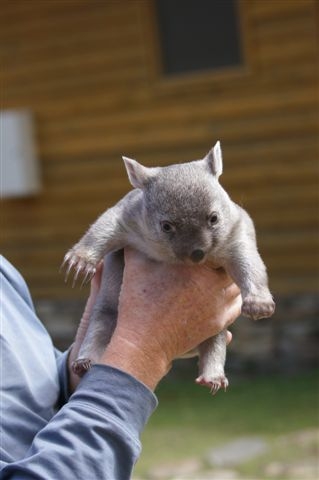
The joey is fully furred. Large ears, appearing too large for head. Tail still visible. Out of pouch more often and quite active while still in burrow. Nibbles grass while poking head out of pouch. Starting to emerge while out of the burrow.
The joey will poke its bottom out of the mothers pouch to pee, sometimes the joey has to be careful as sometimes the opposite is true too and the mother may pee on the baby.
At 9 – 11 months old (weight 3.5 – 6.5 kilograms)
Joey leaves the pouch permanently during this period. Skin on nose and on soles of feet is darkening. Still suckles from the teat, which can be elongated and protruding out of the pouch. Stays close to the mother whenever out of the burrow, often not
breaking physical contact. Eats more and more grass and maybe its mother scats to increase gut flora.
At about 18 months old (weight 16 – 24 kilograms)
The joey is usually independent at this age.
When you come across a wombat which is roadkill and you have removed it from the road and checked for a baby joey – it is good practice to mark the wombat so other carers know that the wombat has been checked.
The mistake has been made of putting a small circle, square or small line on the wombat – here in Tasmania there was an add in the paper complaining about a person going around spraypainting dead wombats genitals (this turned out to be a new carer who marked the pouch with bright yellow spray paint so she knew if she had checked that wombat)
For this reason we suggest a large cross from one side of the wombat to the other. If the wombat is a female you will need to determine if she has a joey in her pouch.
Sometimes if the wombat has been dead for a few days it will have become bloated, smelly, eyes removed and it will be difficult to determine the sex of the wombat. Rescuers checking dead or injured wombats should always check for a joey. Although the dead mother may look old (eyes removed) bloated and smelly – a wombat joey can live up to 5 days inside the pouch AFTER the mother has died. In some roadkill cases, the joey may have been flung out of the pouch during the impact of the accident. It may be on the road near the mother, or if it is bigger (around 2 kilos) the joey may have left the mother’s pouch and be hiding nearby.
The Story of Maggie – a Success Story
This joey was named Maggie when she came into care because she was covered in maggots, she weighed 276 grams.
Her carer did a wonderful job caring for her and she was buddied with another wombat when she was four kilos. She has since been successfully released.
Maggie is only one of many injured tiny wombats that have beat the odds and survived.
The size of the mother’s teats will give you an idea if there is young at heel. When not in use the teat is quite small, however it elongates during use. The teat will be long and extend pass the pouch opening for the joey to suckle. If the teat appears ‘in use’ check the nearby area for the joey wombat as the joey will stay close near it’s dead mother for many days and will be relatively defenceless.
Trying to catch a joey at foot is like trying to catch a greasy piglet, and the joey will become more cunning each time you try to catch him. So it is best to set a trap.
Setting a trap to capture a joey at foot can be a long process but with persistence you will eventually succeed.
The trap needs to be checked often, as a wombat – even a juvenile – left in a trap can cause damage to itself trying to escape.
To set the trap you should:
- Rub a pouch over the dead mother to obtain her scent
- Put the scented pouch into the trap
- Take the dead mother away.
A live joey will need to be taken from the dead mother. This may not be an easy process as the joey will have just gone through a traumatic experience and will resist any attempts to be taken from the pouch.
If you are not able to ease the joey from the pouch you will have to cut the pouch carefully to remove him. You will need a sharp pair of round- ended scissors or a scalpel knife. You will need to put your fingers into the pouch between the joey and the top of the pouch to prevent the joey from being cut.
If the joey is still attached to the teat this should be cut as close to the mother as possible. You should insert a safety pin in the cut teat to stop the joey from swallowing the teat. The teat will be able to be taken from his mouth within a couple of hours. The teat should not be forced from the joey’s mouth as he will release it in due course.
Remember the mother is dead and unable to feel any more pain.
How to care for a rescued joey?
In Australia, each state has different laws as to what you can and cannot do with wildlife, for instance, in NSW it is illegal for a member of the public to raise rescued Australian fauna unless you have a license issued by DECCW.
Tasmania has a similar law but all licenses need to be issued by DPIPWE. Check your state as to what the law is for the care of rescued joeys.
When you have rescued the joey it should be placed on heat as quickly as possible, as they will be in shock. In the field you can use hot water bottles filled with warm tap water. This heat treatment will stop them from losing, or help them retain critical core temperature. If the joey is small enough you can place it against your skin, on the outside of the joey make sure you have it covered with your shirt and something thick like a towel or jacket if you are wearing one.
If the joey has no signs of injury they should be taken straight home for further assessment and care. Once home the wombat should be checked over thoroughly to determine if there are any injuries which were not discernable at the rescue site. Failure to take a bottle or settle may indicate an injury which had not been detected during the initial inspection.
When checking over the joey you should remember that both sides of the wombat should be the same. If one leg looks out of place compare it with the leg on the other side. If one leg is different it may be broken and require vet treatment.
The joey should be weighed during the assessment process. A record of the progress condition and weight of the joey should be maintained during rehabilitation.
Weighing the joey on a daily basis is the best way of determining if he is improving. It takes only a few seconds to check his weight. This process is not stressful.
Once the joey has settled into a routine the weigh-in process may be reduced to once or twice a week. A joey should sleep most of the day. A joey may have internal injuries if they are not sleeping as often and as long as they should, or they are trying to stand, or they are generally unsettled. Vet assistance should be sought to determine the problem.
Temperature requirements are:
Furless or just furred joey (under 600 grams) – 28 to 30 degrees Celsius – NO HIGHER!
Joeys of this size cannot regulate their own body temperature and must be placed on a heat source.
Developing fur (over 600 grams) – 28 degrees Celsius – NO HIGHER!
Joeys of this size are just starting to regulate their own temperature, however there should still be a heat source available. Place the heat source so that the joey can move away from it if it wants to.
Furred joeys – can regulate their own temperature and should not need a heat source. However, a sick or injured joey may need to be kept warm - 28o Celsius – NO HIGHER!
Skin Lubrication
In the wild, the pre-emerged wombat joey lives in a humid environment – the mother’s pouch. In the pouch a thick waxy substance is produced, and the temperature is regulated creating a humid environment that keeps the joey well lubricated. Trying to reproduce a similar humid environment while in care is not recommended as bacterial infections may occur, so alternatively the joey needs to be lubricated on a daily basis.
A furless joey will need to be lubricated over the entire body otherwise the skin can become red, raw, cracked and dry (ensure that you avoid the eye area and nostrils).
A just furred joey will need to have the fleshy bits lubricated, such as the paw pads, nose and sometimes the cloaca.
Once the joey is quite active and the paw pads are darkening, lubrication is not normally required. However, you should constantly check for dry or damaged skin and apply lubrication when required.
Some Lubrications are:
*E45 Cream-dermatological – contains white soft paraffin and hypoallergenic Lanolin
*Olive Oil
*Paw Paw ointment (in the white container, the red container is petroleum based and should be avoided)
*Pure Sorbolene Cream
Oral treatments that can be mixed with normal milk bottles:
*Canola Oil
*Olive Oil
*Megaderm is a product and if used according to instructions (on the bottle) a joey will not need as much topical lubrication as with any other oral treatments.
Never use: Baby oil as it is a real no-no. The mineral content of this application can make a joey very ill when absorbed through the skin or if it is licked off.
What to feed a joey in care?
You will need to determine which milk product you are going to use for your wombat joey and how often it will need feeding. Warm formula should only be fed to a warm joey and one that has had a chance to settle. Try to make the feeding experience as pleasurable as possible – take him to a quiet area which is relaxing and where you will not be disturbed. Remember that joeys drink with their eyes closed – you do not have to wake a wombat to have him feed. Pick the wombat up and place the teat in the side of the mouth. Once the wombat has started to suck, the teat can be moved around to the front of the mouth. Once the joey has become accustomed with the routine he will take the bottle without waking.
- 100- 200 gram Joey - joeys that are between 100 to 200 grams need to be feed every 2-3 hours AROUND THE CLOCK. This can be a tedious and tiring job for a wildlife carer and unfortunately some wildlife carers have chosen to euthanase their animal instead of handing it onto another carer. Just because YOU feel the wombat may not survive, does not mean you are right. Many carers have a wonderful gift for raising tiny joeys - even pinkies. Before passing on the joey to another carer you should always record the joey’s weight and condition, and any other facts about them, eg injuries, treatment provided, response to treatment, where the joey came from, how the joey came into care, if feeding or not. Keeping records for individual wombats is very important so that they can be referred to in the future.
- 200-700 gram Joey - A joey that is between 200 grams to 700 grams should be fed every 3 to 4 hours = 6 to 7 feeds within 24 hours
- 700 grams – 1.5 kilo Joey - joeys that are 700 grams to 1.5 kilos should be fed every 4 hours (around the clock) = 6 feeds
- Joeys over 1.5 kilos - joeys over 1.5 kilos should be fed every 4 hours but the middle of the night feed can be stopped = 5 feeds.
Choosing the right Milk product.
There are three suitable commercial milks available for feeding orphaned wildlife. Do not be afraid to try different milks to suit an individual wombat’s needs and preference. A joey may prefer one milk formula over another. If he refuses to drink a particular formula you should try another brand of milk. A joey may even have an allergic reaction to a particular formula. All of the following products are used successfully to raise wombat joeys.
BIOLAC makes 4 formulas of milk:
*M100G for tiny joeys under 200 grams
*M100 for joeys 200 grams to 1 kilo
*M150 for joeys that have dense fur
*M200 for animals that are producing dark pellets.
Note: It has been noted that that babies weighing more than 800grams tend do better if changed to M150.
WOMBAROO
Wombaroo makes 3 milk formulas for wombats:
* <.4 is for joeys that are less than 40% through pouch life
* .4 is for joeys that are 40% through pouch life
* >.6 is for joeys that are more than 60% through pouch life.
Note: Wombaroo is very concentrated milk, and water MUST be given between feeds. Lots of carers add more water to the formula, but this is NOT what is recommended by the manufacturer. They recommend that extra boiled water be given between bottles.
DI-VETELACT comes in only one strength.
Wombats that refuse a bottle when first in care often will accept Digestelact. Wombats often prefer this sweeter formula when first taking to a bottle. They can be changed over to another milk formula within a couple of weeks.
Probiotics
Regardless of the milk formula you choose for your joey it is recommended that probiotics be used as a general management tool every day - this is advice offered by Dr Anne Fowler BVSc, MACVSc (Torquay Animal House Vet Clinic). Dr Fowler, who is experienced in the care of wildlife, suggests that probiotics, such as those listed below, should be added to milk formulas daily and not just when the joey is ill. Using probiotics daily will reduce the chances of the joey becoming ill with a bacterial infection. Remember! that each animal is different and a probiotic that works well on one joey may cause problems with another – so adjust accordingly.
There are several good probiotics formulas to choose from:
Protexin is wonderful mixture that increases gut flora. It comes in a liquid or powder form which can be added to a milk bottle (after the milk has been heated) or the liquid can be given directly by squirting into the mouth. It is very pricey however – approximately $60 for a 125ml bottle with a pump.
Inner Health and Inner Health Plus are “human” probiotics that have been used very successfully in marsupial joeys. There are dairy free options (no lactose) that come in powder form in a 50g jar, costing around $30. The recommended dose is ⅛ of a teaspoon in each milk bottle (add after milk has been heated). Inner Health and Inner Health Plus can be purchased from most chemists and health food shops.
Yoghurt is a probiotic derived from cow’s milk. Quantities depend on carers preference and the joeys age. Use natural un-flavoured yoghurt only Remember!
that marsupials are lactose intolerant not lactose resistant, so the low levels a joey will receive from yoghurt or other probiotics derived from cow’s milk will not affect it.
Yakult, is another “human” probiotic that can be used successfully. Quantities depend on carer’s preference and the joey’s age. A recommended mixture is 1 bottle of Yakult per litre of milk, alternatively ½ a bottle of Yakult can be mixed with one litre of milk.
Acidophilus powder is another good source of probiotic which is not derived from cow’s milk. Again, quantities depend on individual carer’s preference and the joey’s needs. A recommended quantity is ⅛ of a teaspoon for a furless or just furred or ¼ teaspoon for a furred joey, mixed into each bottle of milk. Acidophilus can be purchased from most chemists and health food stores.
Milk Additives - Generally, other milk additives are not required if using milk formulas correctly, although some carers do like to add different elements for extra nutrition, vitamins or minerals. This is a personal choice for each carer.
Some additives include:
Wombaroo Impact is a colostrum powder that is considered by many as an essential milk additive for furless or just furred joeys to boost the immune system. It can also be used for an unwell joey that may have a compromised immune system. (See the leaflet included in bottles of Impact for directions.) It is an additive to a milk and cannot be given on its own.
Heinz Baby Rice Cereal Powder is sometimes added to Di-Vetelact formula for added nutrition but should only be started once the joey has its eyes open and ears are starting to detach from head.
Olive or Canola Oil is used to keep the coat shiny and in good quality. Only a few drops per bottle are needed.
DON’T BE AFRAID TO TRY DIFFERENT MILKS – ALL THE ABOVE BRANDS ARE GOOD – which one you choose to use is a personal choice…
Some joeys prefer some milk formulas over other formulas. Don’t walk around with blinkers on – just because you prefer one brand over another does not mean your joey will have the same taste as you. If your joey refuses to drink try another band of milk. Joeys can get allergic reactions any of the above mentioned milk powders in rare cases. The milk must then be changed to another brand.
If you have more than one wombat in care at the same time you may need different formulas for each wombat. Making up a days’ supply of bottles at the same time can be very convenient, especially if you are doing a lot of night feeds.
Heating your joeys milk is important – as microwaving the milk should be avoided at all costs especially if microwaving in plastic bottles. If the contents of the bottle are made too hot the milk will de-nature(all the goodness will be destroyed).
The best way to heat a bottle is to place it into a container of boiling water. A cup with hot water from the tap is a good size as it can stand a bottle up safely without the bottle falling over. Care still has to be taken that the contents do not become too hot therefore boiling water is not always the best as it heats fast and overheats the formula. Milk should be offered at body temperature. Coffee warmers have been used with great success for keeping a bottle warm. In-car-cup-warmers (car charger type) are great for road trips.
All equipment and prepared bottles should be kept in the fridge as this keeps them at a temperature that does not promote bacteria.
WHAT IF YOUR JOEY IS DEHYDRATED
To tell if your joey is dehydrated – pinch its skin and if it remains puckered your joey will need to be hydrated.
Mix 5 grams of glucose dissolved in 100 mls of warm boiled water and offer small amounts as often as possible.
Or you can use dehydration serums such as lectade.
There are a variety bottles and teats available. Some joeys are very fussy about the teat used. You may need to try a number of teats before you find one the joey will accept. You should use a bottle not much bigger than the quantity of milk that is being given, as the milk will become too cold if the bottle is too large - you will spend half the feed time reheating the bottle. The size of the teat hole is important when feeding. Wombats have a very strong suck once they have settled into a feeding routine.
If the hole in the teat is too big the milk may get into the lungs or start to pour out of the nose. These do not make for a good feeding session and must be avoided. The solution is to change the teat to one with a smaller hole. Heat a needle (using a match or the flame of a gas-ring), once hot pierce the end of the teat right through – then swirl the needle in a circular motion to widen the teat hole – the hole is the right size if when you place WARM – NOT COLD water into it – it slowly drips out. Some carers will at this point either bite the end of the teat (or chew) to get it to the right size or more experienced carers will initially nip the end with the tip of the scissors blades on an angle.
When caring for joeys we are trying to replicate how the mother does it as close as possible; having a teat with a large hole does not give the joey the ability to suck but makes him take the milk far too fast. This may be convenient for the carer as it gets feed time over quickly, however it is not the correct way joeys should be fed as it may cause colic and leave the joey feeling very distressed and overfull.
All bottles and teats need to be sterilised after each meal. There are many ways to do this. Using a sterilising agent is useful, (steradent for dentures can be used) although some carers will use a cheaper version with just as good results -the microwave. Fill the bottles with water and then heat the bottles so that the water is boiling in them, allow them to cool before handling them, empty and allow them to stand upside down to dry (a human baby bottle stand can be used for this – available on ebay for about $2-$9).
Getting a newly arrived joey to take a bottle can sometimes be a very frustrating job, especially if he is over 2 kilos. You really do need an extra pair of hands to hold these fighting bundles of muscle. They are very strong animals even when very young.
Make sure that the wombat’s eyes are covered and never feed for more than about 30 minutes. The joey should associate the feed as a pleasant time, not a time that is associated with a massive struggle. Small wombats often get blocked noses and this prevents them from sucking. Gently clean the nose with a cotton wool bud or even round- ended tweezers. This process is sometimes easier said than done as wombats do not like you touching their noses.
WOMBAT BISCUITS RECIPE
- Put cut grass in a blender with some water and blend
- Retain blended liquid
- Mix blended liquid with Rolled Oats and a small amount of Critical Care
- Shape mixture into patty sized biscuits
- Bake in a very slow oven for about an hour.
- Any other ingredient (eg grated carrot) that you think may stimulate the wombat’s appetite may be added.
Wombats eat lots and lots and lots of native grass daily, grasses such as tussock, spear grass, kangaroo grass, wallaby grass, even introduced grasses are eaten such as buffel grass. (The grass Kikuyu is not recommended as it can be poisonous in lush spells, particularly after dry conditions and can even cause death).
They will consume vast amounts of grass daily. If you are feeding a number of wombats collecting grass can be very time consuming, particularly during drought or wet weather. Grass collection has to be done on a daily basis or at least every second day to ensure freshness.
Supplementary feeding can be 80% grass and 20% other food such as:
Native grasses such as tussock, spear grass, kangaroo grass and wallaby grass should be generously offered. Introduced grasses such as buffel grass are also eaten. It is best to use grass from where the wombat originated, or will be released too. Kikuyu is not recommended as it can be poisonous in lush spells after dry conditions and can cause death..
Kangaroo Pellets are an ideal non-natural food to offer. They are made specifically for Australian marsupials and have a host of vitamins and minerals included.
Kangaroo pellets can be purchased from most farm produce stores.
Sorghum (also known as Milo) is a very palatable hard grain that is ideal for wetter climates as it will not spoil if it gets wet. WARNING: Green shoots from grain left on the ground are toxic and can cause death.
Completo horse food by Barastoc is a good food supplement. It is highly palatable with lots of vitamins and minerals and acceptable for wombats.
Cop Rice is another type of feed created for horses but can be used for wombats. There are many types of Cop Rice, the general purpose one may be the best choice and this is called Cool Condition. Cop Rice is made from rice and rice bran.
Other grains developed for ruminants, eg Economix, can be offered, however you must ensure that the protein levels are not too high (under 12%).
Dirt. A joey should be offered a considerable amount of dirt as this helps gut bacteria to form.
Food such as unsweetened muesli, rolled oats, carrot, lucerne, sweet potato, etc ,can be offered.
NOT RECOMMENDED: Raw potato is not recommended it has little nutritional value. Unprocessed oats (from produce stores) are also not recommended as the husks can become embedded in the gum. Carrots are not recommended in areas where baiting is carried out (carrots are dosed with 1080 and used in some areas to eradicate rabbits and marsupials).
As the wombat matures you should reduce the amount of supplement food and offer native food that is commonly found in the area where the wombat will be released, this is especially so if a hard release technique is used. Providing too much unnatural food, such as sweet potato or pumpkin, may cause stomach upsets, causing enteritis.
If the wombat becomes accustomed to a small amount of supplementary food the carer has this option available to them and for the wombat, when at times it is impossible to collect the amount of grass required by the wombat.
The grass you are feeding the wombats should be collected from your local area. If the wombat is being released in an area with different grass they should be given grass from that area prior to release. In a perfect wombat world the wombat should be allowed to graze but not many carers are in a position or have the facilities for this to occur. When collecting grass caution should be taken on where it is collected; make sure the area you are collecting from is not contaminated with other animal droppings. Clean water should be made available at all times in a container that cannot be tipped over by the wombat.
The Importance of sunlight
Most living things on this planet need sunlight in order to grow. Access to filtered sunlight is an essential component of raising an orphaned wombat joey.
Wombats cannot tolerate high temperatures so direct sunlight during the hottest parts of the day must be avoided. Early morning and late afternoon are the best time to get your joey out into the sun, but only if the temperature is under 28 degrees celsius. The joey does not necessarily need to be in direct sunlight to benefit from the sun's rays which provide much needed Vitamin D to the joey. A shady spot, say under a tree is perfectly acceptable.
Joeys start to become active out of pouch at around the 3kg to 3.5kg mark (around 8 months of age).
This may be a good time to get your joey outside for play times and for short “wombat walks”. Choose a sheltered area and sit with your joey while it takes time to sniff the bushes and munch on grass. Allow the joey is move back into its pouch, or to you, when it wants too. A furless or just furred joey will also benefit from sunlight, however you should only expose the head of the joey and for short periods at a time. Joeys in the wild are used to living in a dark warm pouch - if you leave the joey exposed for too long it will become distressed. Ensure that you monitor the joey constantly while being in the sunlight - any sign of discomfort in the joey and it should be moved into a more shaded area or returned to the pouch. If you keep the joey in the sun too long it may develop a skin allergy - red raised skin or swollen eyes may need an antihistamine injection to remedy.
The benefits of buddying
In the wild a wombat joey shares a very strong bond with its mother and an orphaned wombat joey will share a similar bond with its “human mum”. A joey that is raised on its own may demand attention most of the time, even while it is sleeping. A single joey that is not offered the company and nurturing it craves may result in a very distressed joey. If the joey manages to escape from its enclosure it will seek out its “mum” and if he / she can’t be found the joey will find the nearest object that smells like “mum” and will curl up and fret itself to sleep.
If joeys are raised in pairs or more, the craving for human company isn’t as strong if it has its buddy to depend on. Although the joey will still want - and should receive - cuddles from “mum” it will not stress when not in continuous contact. In most situations a joey that has been raised on its own will have a tougher time
assimilating into the wild than a joey that has been raised with a buddy. It will take a lot longer for the joey to finally leave home and become truly wild. This may result in a stressed wombat during the release process.
However, not all joeys tolerate being buddied. Wombats have individual characters and just like humans not all wombats get on with each other. It’s uncommon but still possible that you may receive a joey that does not fair well with being buddied, and if this is the case it may be better to raise the joey on its own. This will be a tougher job for the carer and much dedication is required to raise the joey so that it does not crave human company once it has been released.
Housing
When the joey is around 2 kilos they will need to be housed in something a bit bigger than their original cot. At this stage I place the joey in a hanging pouch. This gives them the choice of whether they would like to snuggle up together if they have a buddy, or stay out in their small compound. This hanging pouch stays with the joey until they are fully entrenched in a burrow.
CARE OF THE OLDER JOEY
An older joey which comes into care will need special escape- proof housing. Wombats are great climbers and escape artists. Consequently, their housing will need either a secure lid or very high sides. I have seen some impressive set-ups for juvenile wombats. Your set-up is only limited by your imagination and finances. Furred wombats are not the plaything of children nor are they the family pet. Many wombats in care have become humanised. With the buddy system between two wombats, the wombats bond with each other and not the carer. A joey should not be left to wander the house or yard unsupervised as the wombat may be injured in this unfamiliar environment. While a carer may think it is cute to have a wombat following family members around this is very stressful to the wombat as they are looking for the security of their mother.
Wombats should not be carted around the countryside for the purpose of displaying these animals to friends and relatives. There are times when we must take our wombats with us but it can be done in such a way that they are not noticed. Wombats that need to be taken with their carer can be placed in a carry bag or basket that can be carried without being noticed by members of the public. When feeding is necessary the carer should find a quiet, private area to feed.
There are so many more topics not able to be covered in an article like this – such as the release of the wombats in the field – soft release, hard release, outdoor enclosures etc – but this information can be found in these wonderful manuals available at the website of Fourth Crossing Wildlife:
- “A Guide to the Care of Bare-Nosed Wombats” by Linda Dennis, Anne Fowler, Kim Rolls and Anne-Maree Dineen.
- “Wombat Husbandry” by Donna Treby
Also used was “A basic Care Guide for Bare-nosed wombats by Shirley Lack – Thank-you for your pictures and information
Thankyou for permission to use the article “Breeding Common Wombats” by Cameron Lane and Michele Barnes. Australian Wildlife Experience, Dreamworld, Australia
I would like to offer a personal thank you to David Alder from Wildlife Protection Society of Australia, Linda Dennis from Fourth Crossing Wildife, Thankyou to Stephanie Clark and Wayne White, Tasmania - my mentors and friends - Southern Wildlife Rescue
comments powered by Disqus