The original Bandicoot article can be found in Issue One of the Tas Wildlife Rescue Magazine - click here
Bandicoots - Brown and Eastern Barred
Eastern Barred Bandicoot
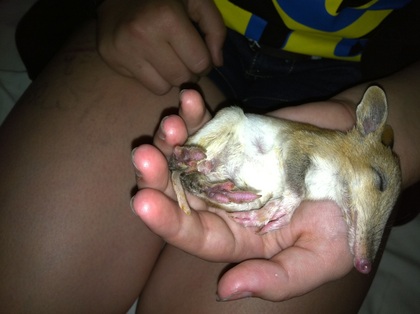
Eastern Barred Bandicoot in care.
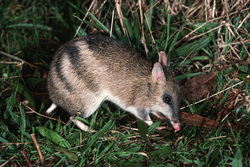
Eastern Barred Bandicoot - (Perameles gunnii) Grey Type locality ‘‘Van Diemen’s Land’’ (Tasmania). Only one form of this species is recognised at present, but two subspecies may be warranted. The Tasmanian form is separated geographically from the mainland form (P. bougainville) by the 200 kilometre wide Bass Strait. The Tasmanian Eastern Barred Bandicoot (Perameles gunnii) is the most strikingly marked member of the genus, with three pale bars on the rump contrasting with darker yellow brown dorsal fur.
The Victorian type (P.bougainville), formerly widespread, has similar barring but is much smaller and has a white venter in contrast to grey venter of the Tasmanian kind.
The tail of the Tasmanian Eastern Barred Bandicoot is dark dorsally only at the proximal end. The Victorian species is dark for its whole length. Did you know you can tell the
difference between the Tasmanian Eastern Barred Bandicoot and the Victorian Eastern Barred Bandicoot by the structure of the feet? The Tasmanian species arise at same level
as 5th digit, whereas in the Victorian species they arise posterior to 5th digit. Both species first and 5th digits of the forefeet are clawless; 2nd and 3rd digits possess strong, long, curved claws, which are used for digging subsurface food items; and 4th digit has a weaker straight claw. Hind feet are slender and elongated. Males are heavier than females and larger in most standard body measurements. The Tasmanian form is somewhat larger than the mainland form. Average adult mass is 750g in
Victoria and 1,000g in Tasmania.
As the eastern barred bandicoot ages, bars may become obscure. Ventral fur is generally pale, slate grey but is white in some Tasmanian specimens. Feet and tail are basically white or pale grey, with tail having a short, darker, dorsal midline at distal end. The Eastern Barred Bandicoot was formerly distributed in south eastern South Australia, south western Victoria and Tasmania. The South Australian population, now extinct, occurred in a small area between the Murray River and the Victorian border and was geographically separated from the Victorian population. In Victoria, the Eastern Barred Bandicoot was virtually restricted to western basalt plains, which extend from near the South Australian border to the Melbourne area. Altitudinal range on mainland Australia is from 40 to 420 metres, with most sites between 40 and 200
metres.
In Tasmania, the eastern barred bandicoot occurs between sea level and 950 metres, with most populations below 400 metres. By 1980, only a single, declining population was extant in Victoria. This decline prompted the establishment and implementation of a recovery program, which involved reintroduction of the Tasmanian species (P. gunnii) principally from captive-bred stock to seven sites within its former range. In Tasmania P. gunnii is widespread in the north and east but is largely absent from the midlands. It is not known from any islands during the modern era, although it has been introduced to Maria Island, close to the Tasmanian south eastern coast.
FORM AND FUNCTION.
The slender head, poorly differentiated neck, strong shoulders and forelimbs, and muscular hindquarters are scarcely balanced by a
thin, short tail. Feet are slender, with long toes and claws. Fur is coarse, and individual hairs are short and stiff.
Hair tracts show patterns of whorls and currents that are characteristic of bandicoots. With courtship behaviour, they exhibit pre-breeding hypertrophy; a pungent odour is secreted by the gland complex. Penis is S-shaped. The Eastern Barred Bandicoot has a well developed,
backward-opening pouch situated ventrally between hind limbs. Eight nipples are normally present. Energy demands of lactation are met by increasing energy intake, effected by a change in the Eastern Barred Bandicoot is physiologically capable of breeding throughout the year, but in Tasmania reproduction may cease during autumn and early winter. In Victoria, reproduction may be reduced or may cease during hot, rainfall-deficient summers but will recommence within weeks of autumn rains. Timing of breeding is strongly correlated with rate of change of minimum temperature.
The Eastern Barred Bandicoot has a gestation period of 12.5 days with an oestrous cycle of 26 days. Litter size ranges from one to five. In Tasmania, litter size averaged 2.5; in Victoria, litter size averaged 2.2. In captivity, average litter size is 1.8. Most litters (78% in Tasmania and 80% in Victoria) contain two or three pups. Litter size may increase in spring because of an increase in available
food.
Sex ratio of pouch young is 1 male: 1 female. Pouch life lasts 55 days, after which young are left in a grass and leaf nest in a scraped depression until weaned at 70–80 days.
Survival of pouch young in Victoria was 92% but decreased markedly post-weaning. Both sexes may begin to breed at 4 months of age.
However, breeding may be delayed by 6-8 months when food resources are limited.
Neonates are 13.5mm long (crown to rump), have a head length of 5.75mm and weigh 200mg. Neonates are reddish pink with hairless, glossy
skin. The mouth is circular, and the enlarged tongue firmly encloses a nipple. Nostrils are tubular and prominent, and a pigmented area
represents the eyes. Neither ears nor sex are distinguishable at birth.
Forelimbs are well developed, but hind limbs are rudimentary. Tail is well developed, 3-4mm long. Postnatal development is very rapid. Ears are visible, although fused to head, at five days and are free at 15 days.
Eyes open at 30–35 days. Fur begins to develop at 35–40 days and at 50 days the young is fully furred, open eyed, erect eared, vocal and may voluntarily emerge from the pouch for short periods, although full coordination of movement has not developed. Length of head is directly
correlated with age, enabling close estimates of birth dates and hence time of breeding from measurements of young in the field.
Habitat of the eastern barred bandicoot is grassy woodland and grassland, normally on flat or gently undulating plains. Native grassy regions in Victoria have tussock grasses of the genera Themeda, Danthonia, Stipa and Poa, together with associated forbs, many of which produce underground storage organs such as tubers or bulbs. These grasses have an average height of 500mm. A sparse shrub layer is frequently present, which may include Acacia, Banksia, Allocasuarina and Hymenophyllum. Where trees are present, they are species of Eucalyptus,
commonly E. camaldulensis, which has a tall, spreading habit in maturity. In settled areas, the Eastern Barred Bandicoot uses heterogeneous
habitat provided in gardens and along fence lines on farmland and will often use widespread introduced weeds such as Ulex europaeus or Juncus acutus for shelter. In housing developments, particularly long-established ones, Eastern Barred Bandicoots shelter and often nest under outbuildings or in rubbish piles.
In Tasmania, the Eastern Barred Bandicoot colonised farmland created by clearing of former forest and is now rare in its presumed original grassland or grassy woodland habitat. The Eastern Barred Bandicoot is omnivorous, consuming a wide range of invertebrate and plant material,most of which is obtained from the soil or litter by the excavation of characteristic conical diggings, the incidence and number of which may be used as an index of population size. Earthworms (Lumbricidae) are a major food, especially in the wetter months. Insects and their larvae are also favoured and include cockroaches (Blattidae), field crickets (Teleogryllus commodus), Coleoptera (especially Scarabaeidae), and moths and caterpillars (Lepidoptera). Bulbs and tubers of native and introduced plants are eaten, as are fruits of the introduced blackberry (Rubus) and windfall orchard fruits.
The Victorian type (P.bougainville), formerly widespread, has similar barring but is much smaller and has a white venter in contrast to grey venter of the Tasmanian kind.
The tail of the Tasmanian Eastern Barred Bandicoot is dark dorsally only at the proximal end. The Victorian species is dark for its whole length. Did you know you can tell the
difference between the Tasmanian Eastern Barred Bandicoot and the Victorian Eastern Barred Bandicoot by the structure of the feet? The Tasmanian species arise at same level
as 5th digit, whereas in the Victorian species they arise posterior to 5th digit. Both species first and 5th digits of the forefeet are clawless; 2nd and 3rd digits possess strong, long, curved claws, which are used for digging subsurface food items; and 4th digit has a weaker straight claw. Hind feet are slender and elongated. Males are heavier than females and larger in most standard body measurements. The Tasmanian form is somewhat larger than the mainland form. Average adult mass is 750g in
Victoria and 1,000g in Tasmania.
As the eastern barred bandicoot ages, bars may become obscure. Ventral fur is generally pale, slate grey but is white in some Tasmanian specimens. Feet and tail are basically white or pale grey, with tail having a short, darker, dorsal midline at distal end. The Eastern Barred Bandicoot was formerly distributed in south eastern South Australia, south western Victoria and Tasmania. The South Australian population, now extinct, occurred in a small area between the Murray River and the Victorian border and was geographically separated from the Victorian population. In Victoria, the Eastern Barred Bandicoot was virtually restricted to western basalt plains, which extend from near the South Australian border to the Melbourne area. Altitudinal range on mainland Australia is from 40 to 420 metres, with most sites between 40 and 200
metres.
In Tasmania, the eastern barred bandicoot occurs between sea level and 950 metres, with most populations below 400 metres. By 1980, only a single, declining population was extant in Victoria. This decline prompted the establishment and implementation of a recovery program, which involved reintroduction of the Tasmanian species (P. gunnii) principally from captive-bred stock to seven sites within its former range. In Tasmania P. gunnii is widespread in the north and east but is largely absent from the midlands. It is not known from any islands during the modern era, although it has been introduced to Maria Island, close to the Tasmanian south eastern coast.
FORM AND FUNCTION.
The slender head, poorly differentiated neck, strong shoulders and forelimbs, and muscular hindquarters are scarcely balanced by a
thin, short tail. Feet are slender, with long toes and claws. Fur is coarse, and individual hairs are short and stiff.
Hair tracts show patterns of whorls and currents that are characteristic of bandicoots. With courtship behaviour, they exhibit pre-breeding hypertrophy; a pungent odour is secreted by the gland complex. Penis is S-shaped. The Eastern Barred Bandicoot has a well developed,
backward-opening pouch situated ventrally between hind limbs. Eight nipples are normally present. Energy demands of lactation are met by increasing energy intake, effected by a change in the Eastern Barred Bandicoot is physiologically capable of breeding throughout the year, but in Tasmania reproduction may cease during autumn and early winter. In Victoria, reproduction may be reduced or may cease during hot, rainfall-deficient summers but will recommence within weeks of autumn rains. Timing of breeding is strongly correlated with rate of change of minimum temperature.
The Eastern Barred Bandicoot has a gestation period of 12.5 days with an oestrous cycle of 26 days. Litter size ranges from one to five. In Tasmania, litter size averaged 2.5; in Victoria, litter size averaged 2.2. In captivity, average litter size is 1.8. Most litters (78% in Tasmania and 80% in Victoria) contain two or three pups. Litter size may increase in spring because of an increase in available
food.
Sex ratio of pouch young is 1 male: 1 female. Pouch life lasts 55 days, after which young are left in a grass and leaf nest in a scraped depression until weaned at 70–80 days.
Survival of pouch young in Victoria was 92% but decreased markedly post-weaning. Both sexes may begin to breed at 4 months of age.
However, breeding may be delayed by 6-8 months when food resources are limited.
Neonates are 13.5mm long (crown to rump), have a head length of 5.75mm and weigh 200mg. Neonates are reddish pink with hairless, glossy
skin. The mouth is circular, and the enlarged tongue firmly encloses a nipple. Nostrils are tubular and prominent, and a pigmented area
represents the eyes. Neither ears nor sex are distinguishable at birth.
Forelimbs are well developed, but hind limbs are rudimentary. Tail is well developed, 3-4mm long. Postnatal development is very rapid. Ears are visible, although fused to head, at five days and are free at 15 days.
Eyes open at 30–35 days. Fur begins to develop at 35–40 days and at 50 days the young is fully furred, open eyed, erect eared, vocal and may voluntarily emerge from the pouch for short periods, although full coordination of movement has not developed. Length of head is directly
correlated with age, enabling close estimates of birth dates and hence time of breeding from measurements of young in the field.
Habitat of the eastern barred bandicoot is grassy woodland and grassland, normally on flat or gently undulating plains. Native grassy regions in Victoria have tussock grasses of the genera Themeda, Danthonia, Stipa and Poa, together with associated forbs, many of which produce underground storage organs such as tubers or bulbs. These grasses have an average height of 500mm. A sparse shrub layer is frequently present, which may include Acacia, Banksia, Allocasuarina and Hymenophyllum. Where trees are present, they are species of Eucalyptus,
commonly E. camaldulensis, which has a tall, spreading habit in maturity. In settled areas, the Eastern Barred Bandicoot uses heterogeneous
habitat provided in gardens and along fence lines on farmland and will often use widespread introduced weeds such as Ulex europaeus or Juncus acutus for shelter. In housing developments, particularly long-established ones, Eastern Barred Bandicoots shelter and often nest under outbuildings or in rubbish piles.
In Tasmania, the Eastern Barred Bandicoot colonised farmland created by clearing of former forest and is now rare in its presumed original grassland or grassy woodland habitat. The Eastern Barred Bandicoot is omnivorous, consuming a wide range of invertebrate and plant material,most of which is obtained from the soil or litter by the excavation of characteristic conical diggings, the incidence and number of which may be used as an index of population size. Earthworms (Lumbricidae) are a major food, especially in the wetter months. Insects and their larvae are also favoured and include cockroaches (Blattidae), field crickets (Teleogryllus commodus), Coleoptera (especially Scarabaeidae), and moths and caterpillars (Lepidoptera). Bulbs and tubers of native and introduced plants are eaten, as are fruits of the introduced blackberry (Rubus) and windfall orchard fruits.
Male home ranges exceed those of females but generally reflect habitat quality. Males may have ranges up to an order of magnitude larger than those of females (males 25.6 hectares versus 3.2 hectares females, but core ranges are much smaller: 4–5 hectares for males, 1.5–2.5 hectares for females).
Home ranges overlap, especially male ranges with those of females. Densities vary with habitat quality and range between 0.35 and 4.8 animals.Young males may disperse up to 2.3 km, but most movements are 2 km.
Emigration rates are between 16.5% and 25.5%.
In Victoria, few other native mammal species share habitats with the Eastern Barred Bandicoot. The introduced European rabbit is widespread throughout the range of the Eastern Barred Bandicoot. This rabbit competes with Eastern Barred Bandicoots by reducing habitat through excessive grazing and may exclude Eastern Barred Bandicoots from favoured shelter areas. In Tasmania, the Southern Brown Bandicoot Isoodon obesulus is often sympatric but prefers heavier cover and is more cryptic in behaviour. Nevertheless, it may compete for food. Predators such as snakes, raptors, carnivorous marsupials, the introduced red fox, cats and dogs may be responsible for some of the mainland bandicoot population declines.
At Hamilton, domestic cats were the major cause of mortality among juvenile bandicoots, and red fox control is an essential component of conservation management at reintroduction sites. Wild and domestic dogs are important predators where bandicoots occupy farmland and suburban environments.
Infection by the protozoan parasite Toxoplasma gondii commonly causes mortality in captive and wild populations. Cats are the definitive host and probable carrier of infection to bandicoots; infective oocysts are shed in cat faeces and then ingested by bandicoots either directly from soil or via the gut content of invertebrates. Toxoplasmosis has been reported from the Eastern Barred Bandicoot in both Tasmania and Victoria. It has also been experimentally induced in captive Eastern Barred Bandicoot via earthworms.
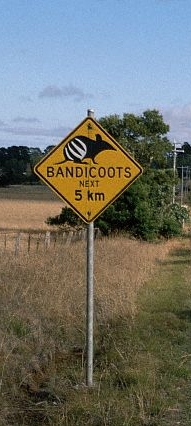
The Eastern Barred Bandicoot lives 20–30 months in the wild but can live 5–6 years in captivity. Causes of mortality in the wild include predation, disease, poisoning by pesticides and collision with motor vehicles.
Cats killed predominantly juveniles, but road-killed animals were mainly adults. Causes of death of 135 Eastern Barred Bandicoots over a 10
year period were 63% roadkills, 18% cats, 8% disease, 5% trapping accident, 4% machinery (mowers) and 2% dogs.
The most common causes of death in 270 wild and captive bandicoots was trauma, including roadkills, predation, and trapping injury (71%); infection and poisoning were the cause in 12% of deaths.
Bandicoots suffering from taxoplasmosis may be more at risk from predators and motor vehicles because of uncoordinated and often aberrant behaviour that results from the disease.
The Eastern Barred Bandicoot breeds readily in captivity, and its husbandry is well documented. Eastern Barred Bandicoots have little economic impact on the community, although they were captured and eaten by aboriginal Australians and probably by early European settlers. Their skins were used for clothing and other artifacts. Nuisance damage occurs when animals dig into private gardens.
Rabbit trapping was an important local industry in the late 19th century and trappers considered bandicoots a nuisance when they were captured.
Live capture is most effectively done using baited wire-mesh cage traps. Protocols for trapping have been developed to reduce potential injury to the animal. Marking methods include tagging ears (fingerling tags), tattooing ears, and implanting microchips. The Eastern Barred Bandicoot is essentially solitary, other than when courtship and mating occurs or when females have dependent young.
Mutual avoidance is usual. Males are more aggressive than females and occasionally chase and attack other males, although scarring or injury is rare.
In a confined reintroduced population with strong male bias, injury from fighting was more common. Most behaviour in captivity mimicked that described for wild Eastern Barred Bandicoots.
Adults were tolerant of juveniles, even those of the same sex. Males initiate courtship when a female becomes receptive; copulation is brief but frequent, and many males may mate with a single female over several hours. A maximum of 10 males mated with a single female, 3–4 times each; this behaviour may have been the result of a male-dominated population. Mating is achieved with the male standing erect behind the crouched female, with his forelegs folded back against his body. Contact is only in the genital region. Eastern Barred Bandicoots of both sexes usually resume normal foraging activity straight after.
Eastern Barred Bandicoots have a limited range of vocalizations, visual displays, and social behaviours.
‘‘Honking’’ is associated with alarm, and ‘‘sniffing’’ is associated with recognition.
The pale belly may be a visual signal of submission, although an erect stance with open, gaping mouth occurs during aggressive encounters.
The Eastern Barred Bandicoot is relatively long limbed and can move very rapidly quadrupled using either a synchronous running or an asynchronous galloping gait. Sudden jumps (up to 1.5 m high) during escape responses and the capacity to rapidly change direction facilitate evasion of predators.
Food is normally obtained by digging conical holes in soil with front feet. After potential prey has been located, smell may confirm presence of
food during digging. Feeding at one site may last 25 minutes and 90% of the time may be spent actively foraging or consuming food items.
Food may be rolled and kneaded in the forepaws; this behaviour may be due to unfamiliarity with the item, a need to crush the exoskeleton of
arthropods (insects/arachnids), or a way to remove irritable hairs from caterpillars.
Drinking is rarely observed; water is lapped with a forward and upward movement of the tongue.
Nests are constructed at or just below ground level, depending upon season and soil moisture. Nests are excavated, using only forefeet, in a rapid scratching motion. Soil and litter are pushed back through hind legs, and back is arched to accommodate accumulated material. Nests may be used for several days but may also be temporary.
On occasion, nests are built in hollow logs or underneath rocks or other solid features. In suburban Hamilton, nests often are made under buildings or in piles of rubbish.
Rabbit burrows are used for shelter and perhaps also for nesting.
Most (78%) of 20 nests located by radiotelemetry were within three metres of a woody plant and were frequently very cryptic in placement.