
The Platypus Article - Can be found in Issue Two of Tas Wildlife Rescue Magazine - click here
PLATYPUS
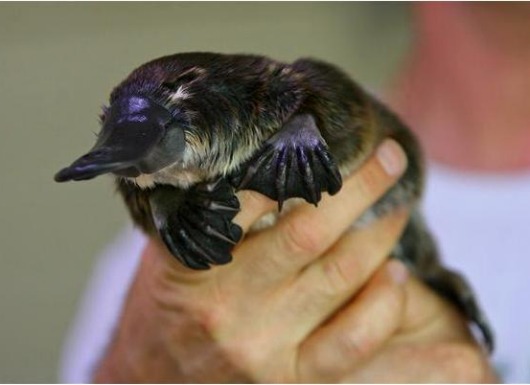
Platypus Pup Credit: Healesville Sanctuary
The Platypus – taxonomic family name for Platypus - Dr Shaw, in his scientific description of 1799, gave the name Platypus anatinus, from Greek and Latin words meaning "flat-footed, duck-like". However, when it became known that Platypus had already been used to name a group of beetles, a new term had to be adopted. The official scientific name became and remains Ornithorhynchus anatinus, with the first word meaning "bird-like snout".
The identification of a platypus is unmistakable. With its broad bill and broad paddle like tail - there is simply not another animal that looks like it.
The preferred plural of platypus is either "platypus" or "platypuses", depending on which dictionary you consult. (We [Tas Rescue Magazine] will use the former for the sake of simplicity.) The term "platypi" is no longer considered to be valid.
There is no accepted term - equivalent to pup or cub - to describe a baby platypus. One possible name recently suggested is a "platypup".
In recent years, the word "puggle" has been commonly used for Baby Platypus. This term was applied to baby echidnas some years ago because of their resemblance to Puggles, an American soft-toy character. (It is understood that the toy company concerned may have considered legal action to protect its registered trade-mark in relation to unauthorised usage). This name is now being applied to baby platypus or it’s other name Platypup is also accepted. However because the baby platypus and baby echidna doesn't look very much alike once they get past the initial post-hatching "jelly-bean" stage, scientists and researchers argue that the baby platypus doesn't resemble a puggle and is possibly illegal to use and they are pushing to have the word Platypup approved.
So this e-magazine (Tas Wildlife Rescue) will refer to a platypus baby from here on as a ‘Platypup’, based on this research.
Platypus are wild animals with specialised living requirements. It is illegal for members of the public to keep them in captivity. A platypus which has been accidently captured along a stream or found wandering in an unusual place should never be taken home and treated as a pet, even for a brief time. The animal will not survive the experience.
Only a small number of Australian zoos and universities hold permits to maintain platypus in captivity for legitimate display or research purposes. Current Australian government policy does not allow this species to be taken overseas for any reason.
The platypus lives only in Australia. Populations occur in Tasmania, Victoria, New South Wales and Queensland to about as far north as Cooktown. In South Australia, apart from an introduced population surviving on Kangaroo Island, the species is considered rare and possibly extinct in the wild.
Because platypus are predators near the top of the food chain and require large amounts of food to survive (up to about 30% of a given animal's body weight each day), it is believed that their numbers are most often limited by the availability of food, mainly in the form of bottom-dwelling aquatic invertebrates.
Until the early twentieth century, platypus were widely killed for their fur. The species is now protected by law throughout Australia.
Platypus fur is extremely fine and even denser than that of polar bears and river otters, with 600-900 hairs covering each square millimetre of skin! Platypus fur also has two layers - a woolly undercoat and longer, shiny guard hairs - which work together to trap a layer of air next to the skin, keeping most of the animal's body dry even when diving.
For the platypus to stay warm while in the water, its fur must remain completely clean and waterproof, and not be fouled by oil or other pollutants.
A healthy platypus normally maintains its body temperature at close to 32 oC, about 5 oC less than that of humans. This reduces the rate at which a platypus loses heat to the water, helping to ensure that the animals don't become chilled even when swimming all night in near-freezing conditions.
The combination of a naturally low body temperature and thick fur coat also means that the platypus overheats rapidly if exposed to warm conditions on land.
In captivity, a platypus has been observed to remain underwater for up to 5 minutes while resting quietly under a log. When searching actively for food, a platypus will usually remain submerged for less than a minute before returning to the surface to breathe.
Like most diving mammals, the platypus has blood that is very rich in oxygen-carrying haemoglobin and red cells. The platypus can also reduce its need for oxygen when diving by lowering its heart rate dramatically, from more than two hundred beats per minute to less than ten beats per minute.
The platypus swims using only its front limbs for propulsion. The front feet are equipped with large webs of skin that serve as highly effective paddles. When out of the water and moving around the webbing is folded under the animal's feet, making it easier for the animal to walk and to uncover broad nails, which are ideally suited for digging. The legs of the platypus are short and each foot has five clawed digits.
Unfortunately, these highly specialised front feet are not adept at removing objects that become caught around the head or body. As a result, platypus can die after becoming ensnared in litter such as loops of nylon fishing line or plastic six-pack holders.
The hind feet, which are only partially webbed, act as steering rudders. The back feet end in a series of sharp, curved claws that are used like a comb to keep the animal's fur tidy and waterproof.
Both the front and back legs extend out horizontally from the body, providing a powerful swimming and digging action. However, it also forces the platypus to shuffle like a lizard when walking on land or crossing shallow areas of water, making them vulnerable to predators such as foxes and dogs.
However the male Platypus has a venomous spur. A characteristic that helps add even more to the male platypuses uniqueness, this ability to produce and deliver venom. The venom is produced in crural glands, located on both hind legs under the dorsal thigh muscles. How the crural gland actually creates venom was not found by the writer of this article. The size of the gland changes with the season, as well as the volume of the venom. It gets larger during the spring time, which coincides with breeding season. The gland secretes venom through a duct which connects to a reservoir at the base of a keratinous spur. A spur is located on the rear side of each of the hind legs, and on a mature adult, is about 15 mm long. The platypus strikes by erecting its spur, and then squeezing the victim between its hind legs. The motion forces the spur into its victim, and simultaneously squeezes venom from the reservoir through a channel going through the spur, and then out through the tip. A mature male platypus can inject 2-4 ml of venom at a time, depending on the season.
It is a colourless fluid containing a mixture of proteins and peptides. When injected the person feels an agonising pain that seems to suggest that it contains one or more extremely potent neuroirritants. As to what these neuroirritants are and the way in which they act is not yet known. However, one protein has been identified from the red blood cells of a human victim. It is the enzyme phospholipase D, which is found in some snakes, including the Australian Tiger Snake, but no other mammals.
The venom is potent enough to kill dogs, but in a human it causes severe pain, which is not alleviated by analgesics. The pain can last for at least 36 hours and the limbs may swell up like balloons. Following this, a rash can last for several months. A potential gamma-globulin antibody has been found for the venom, which could lead to an antivenene to treat a person who has been spurred.
The platypus uses its spur against other male platypus mainly to fight for females during the breeding season. Males are extremely territorial and will fight to hold their territory. It can also be used as a potentially effective mechanism for males to ensure that they have spatial separation from each other.
The first-aid for an attack is to avoid contact with the site of the sting and restrict movement of the limb. The pain cannot be masked by morphine. There is also no antivenin available. The only treatment that has been found to help reduce the pain is anesthetic blockade coupled with narcotic intravenous infusion . This works by stopping the conduction and/or transmission of nerve signals. Only then can morphine (or another narcotic) be used to help treat the pain. Fenner et al. (1992)went on to explain that this treatment only helps alleviate some of the pain and must be administered for several days.
Looking at the way the spur changes during the first few years of the life can be used to age male platypuses. Up to the age of 6 months, the spur is enclosed in a sheath. Between 6 and 9 months about a third of the spur can be seen poking out of the sheath, which has begun to break down. Between 9 and 12 months (sub-adult) the sheath has broken down to such an extent that about two-thirds of the spur is showing. When the male has reached about 2 years the sheath can still be seen covering the base of the spur.
Juvenile females have a rudimentary version of the spur, but, unlike juvenile males, they lose it within their first year. The spur of the female does not change in size during the 8 to 10 months it can be seen, after which it is shed. Some fishermen used to believe that the platypus could breathe through its back because when it was submerged small bubbles of air would escape from where it was trapped and appear on the surface.
The webbed feet are most likely to be the reason why the platypus got its name. This is because the webbed feet may give the impression that the platypus is flat-footed, which is what its name means.
The platypus hunts underwater and, predominantly, at night. In such conditions, hearing and eye-sight are of little use in detecting prey. Accordingly, the platypus closes both its eyes and ears (which are located in a groove behind the eyes) and relies on its "sixth sense" - an electro-receptor system, located in the bill which helps it detect the small flickers of electricity produced by the aquatic creatures that it feeds on. The bill also contains various pressure sensors which, together with the electro-receptors, probably assist navigation while submerged.
Although similar in appearance, the Platypus bill is nothing like a ducks. It is pliable and more like rubber whereas a ducks bill is hard. The platypus' bill is covered with a soft, moist, naked, leathery skin, which, when touched, feels soft and rubbery. It is reported that the bill has a certain amount of flexibility, but the bones of the upper and lower jaw limit this. These are further apart at the tip than at the head. This structure can be found in all mammals, whereas other vertebrates, e.g. reptiles, have a lower jaw that is made up of several pairs of bones. The top of the bill is a blue-grey colour and slightly back from its tip are two nostril holes. The positioning of these allow it to breathe while the rest of its body is submerged. The lower bill, which is a pale pink or mottled colour on its underside, is smaller than the upper bill. At the back of the bill is the frontal shield that stretches slightly up and over the forehead. It is unknown as to what its purpose is.
The bill's entire surface is covered with openings to sensitive nerve endings, which makes it very sensitive to touch. The platypus uses its bill in order to search for food and to find its way around when it is submerged. The platypus does not have any teeth instead, it has horn-like grinding pads, which cover most of each jaw. At the front of the bill these pads are sharp ridges, but as they progress towards the head they become more flattened, which makes them suitable for grinding food. The tongue is flattened, and works against the grinding pads to aid chewing. These pads get worn down fairly rapidly, but this is compensated by the fact that they are continuously growing.
The receptors in a platypuses bill are extremely sensitive. Credit: Platypus – Worlds Strangest Animals (Documentary)
The platypus was once commonly known as a "duckbill". In fact, its bill is rubbery and flexible, not hard like that of a duck. Although the bill is quite tough, to enable the platypus to search for food amongst rocks and gravel, it is covered with skin. Sometimes platypus are found with scars on their bill, suggesting that they have cut themselves on sharp objects in the water, such as broken glass and wire, or have been snagged on fishing hooks.
There are two grooves situated on either side of the platypus's head, just behind the bill. The eyes are situated at the front of each groove, and at the back are the ear openings. The platypus has no external ear lobes.
When diving, the platypus closes both its ears and eyes. This means it has to rely on other organs for finding its way about underwater, hence the sensitivity of its bill. However, when on land it has the use of its eyes, which are very acute over long distances. However, because of their location, it is unable to see what is literally 'under its nose'.
The platypus' ability to smell is not as developed as the echidnas.
The platypus has a skeleton that is heavy and strong enough to support large muscles, which it uses for both digging and swimming. The front limbs, especially, use large muscles in order to assist in digging and swimming. In order to assist the platypus’ movement the leg bones and the shoulder girdles, which support these bones, are all fairly large.
Some early reports suggested that the platypus slapped the water with its tail to make warning sounds, similar in behaviour to beavers. In fact, there is no evidence for this, although when startled platypus will sometimes make a "splash-dive" - a rapid dive in which they seem to use the tail to thrust themselves downwards quickly. This can produce quite a loud noise, and perhaps this was the origin of the tail-slapping myth.
The main function of the tail is to store up to 50% of the animal's body fat, providing an energy reserve if food is scarce. Researchers rate the general physical condition of a platypus on a five-point scale by applying a "squeeze test" to the tail in order to assess the amount of fat stored there.
A female platypus can also use her tail to collect leaves to make a nest in the breeding chamber. She then uses her curled up tail to hold eggs against her stomach during incubation.
The platypus tail is broad and paddle-like, quite unlike the tail of the Australian water-rat (the animal most likely to be confused with a platypus by observers) which is thin and also has a distinctive white tip.
Unlike the soft fur on the body of a platypus, the hair on the upper side of the tail is quite hard and bristle-like, reflecting the fact that the tail is used to push loose earth out of the way when a platypus is digging a burrow.
The Platypuses means of reproduction and waste elimination are unique. Monotremes have a cloaca, which is a single opening for passage of solid and liquid waste, where the transfer of sperm takes place, and in females, the laying of eggs. This feature is shared only with birds and reptiles. In order to determine an individual's sexuality, i.e. males or females, sex chromosomes are required. The platypus has 26 pairs of chromosomes, which is 3 more pairs than humans have. Of these, five of the pairs are sex chromosomes - humans only have one pair.
The penis of the male platypus is located inside the cloaca and is everted through this opening for the purpose of reproduction. Semen is carried from the testes to the penis by the urethra. The testes are located within the platypus’ body and this condition is called testicond. Only a few other mammals, e.g. the elephant, the echidna, some shrews, have a similar set-up. Other mammals have external testes contained in a scrotum, which hangs from the body.
Some have suggested that they can sex a platypus by feeling for the penis which is a lump against the epipubic bones, similar to that of an echidna. If this is the case then it stands to reason that a Platypus can be palpitated like an Echidna. Whether this has been done in the field is yet unknown. (If you look in the Echidna article of this same magazine you will find Dr Peggy Resmillers instructions on how to sex an adult echidna using Palpitation.)
It has been reported that the platypus is capable of making noises, but these have rarely been heard. They include a growl that is similar to the one a puppy would make and a noise that is comparable with that of a brooding hen. It is thought that they would use this when they are in danger.
The platypus will usually sleep in a curled position on its side. While in this state it has been found that the platypus has rapid-eye movement (REM). In research on humans it seems to be that REM is important in allowing the brain to either develop nerve endings or restore their sensitivities. This seems to indicate that it uses sleep to allow its brain to develop/recharge itself.
The courtship of a Platypus is a dance – a male grasps the females tail and a courtship dance begins – the female will sommersault and dive and flip and the male all the time will hold her tail with his bill and follow her every movement – this courtship dance will last for about 20 mins – then the male mounts her – she can lay between one and three eggs.
The female will carry a mark from her courtship dance – her tail will have a tell tale bare patch where the male has hung on. Whether she mates with one male or a dozen males is still one of the great mysteries of the Platypus.
A female prefers to build her nesting burrows several metres up from the creek bed so she is protected from flooding creeks / rivers. Where resting burrows are low down sometimes in the water or just under the ledge where roots and plants hide the entrance.
Platypus eggs have been recorded from August to October, with some evidence that the animals breed a few weeks earlier in Queensland as compared to Victoria and Tasmania. As platypus eggs are believed to develop for about a month inside the mother after being fertilised, platypuses presumably breed as early as July in the warmer parts of their range.
The platypus is a warm-blooded mammal which lays and hatches eggs. A female platypus produces a clutch of one to three eggs in late winter or spring. The eggs are 15-18 millimetres long and have a thin, leathery shell, like those of snakes and lizards. The mother is believed to incubate them between her lower belly and curled-up tail for a period of about 10 or 11 days as she rests in an underground nest made of leaves or other vegetation collected from the water.
Male platypus do not help to raise the young.
A female platypus does not have teats. Instead, a rich milk is secreted from two round patches of skin midway along the mother's belly. The baby platypus feeds by slurping up milk with rhythmic sweeps of its stubby bill, it finds the milk by its huge nostrils which are well formed even at 6-7 weeks of age. When the juveniles first enter the water at the age of about four months, they are nearly (80-90%) as long as an adult. During the long period when lactation, the production of milk, is not required these glands are quite small, i.e. only spread over a small part of the female’s abdomen. However, when milk is required by the young during the lactating season they become extremely large, and can cover up to a third of this area.
Male and female platypus are both believed to be capable of first reproducing at the age of two years.
What happens in the nest of a mother?
Filmmakers David Parer and Elizabeth Parer-Cook ….. have filmed a documentary (Platypus; World’s Strangest Animal) and Liz had this to say: “the mother was gentle and nurturing. She would call before she came in and they would respond, and every time she went out she would completely remake the nest."
Thanks to the wonderful documentary - Platypus; World’s Strangest Animal – here are some points of interest:
At maturity, male platypus measure on average 50 centimetres in total body length (bill tip to tail tip). They typically weigh 1.2-2.6 kilograms, although the heaviest platypus yet recorded (captured in Tasmania) tipped the scales at 3 kilograms. Adult females are smaller, measuring an average 43 centimetres in total body length and weighing 0.7-1.6 kilograms.
Platypus have been recorded to live to at least 16 years in the wild, though most individuals die at a much younger age. The longest reliable age record for a platypus in captivity is 17 years. More research is required to establish the animals' typical life span in the wild, although estimates of about 4-5 years for males and 6-8 years for females are not unreasonable.
Although Platypus hunt in solitude – the Australian cormorant (bird) has become quite clever and will dive with the platypus during feeding – the platypus stirs up the bottom and eats what his bill can sense – shrimps and small fish are flushed out by the foraging platypus and the cormorant eats them.
(End of excerpt)
Reports by naturalists indicate that very large Murray cod and birds of prey (hawks, eagles and owls) occasionally capture platypus in the water, while carpet pythons, goannas and Australian water-rats may attack young platypus in the burrow. It has also been suggested that predation by crocodiles may contribute to the lack of platypus on Cape York Peninsula in far north Queensland. Since European settlement, introduced species such as foxes, dogs and cats have probably become the major predators on platypus.
Platypus use two types of burrows: "nesting burrows" (which provide shelter for a mother and up to three offspring) and "camping burrows" (all other burrows).
If provoked, a male platypus can use his spurs as a defensive weapon. In the days when platypus were shot for their fur, dogs were sometimes killed after being sent to retrieve a wounded male from the water. These days, people mainly get spurred when they handle a platypus which has become hooked inadvertently on a fishing line.
Platypus venom is not considered to be life-threatening to a healthy human. However, spurring is painful - in part, because platypus spurs are sharp and can be driven in with great force. As well, platypus poison triggers severe pain in the affected limb and can result in quite spectacular localised swelling. No one actually knows how dangerous platypus venom is to other platypus. In captivity, a 15-year-old male died some days after being spurred by a younger adult in December (after the breeding season). However, it remained unclear whether the resulting tissue damage was due to the effects of poison or simply physical trauma and possible infection.
Platypus should never be handled, except in an emergency - for example, to extract a fishing hook that has become embedded in a platypus's bill. In such a situation, the platypus can be restrained by holding its body flat against the ground while the hook is carefully removed - ideally by a second person. Special care should be taken to avoid holding or supporting males (or animals of undetermined sex) from below. If it is necessary to pick up a sick or injured animal (for example, to place it in a secure bag or box before taking it to a veterinarian) the safest technique is to grip the platypus by the middle or end of its tail (but not the tail base, which an animal can reach with its spurs). To reduce struggling, cover the animal's eyes with a folded towel or item of soft clothing while it is being handled.
WHAT SHOULD I DO IF SPURRED?
If spurred, take first-aid action as for snake-bite - i.e.
immobilise the injured limb with a pressure-bandage and splint;
keep calm and avoid strenuous movement;
seek medical assistance as soon as possible.
The pain appears to be controlled more effectively by local nerve-blocking agents than by morphine-related drugs. Placing ice or cold-packs on the site of the spur wound is NOT advisable as this may actually intensify the discomfort.
What to feed a Platypup?
A farmer who was extending his dam and accidentally killed a mother platypus in her burrow – being a wildlife lover he searched carefully and found a 200gram – six week old male Platypup. He rushed it to the Healesville Sanctuary in Queensland and Ian Elton became his loving, dedicated carer.
How did he do it?
The carers figured out that the milk supplement used for the echidna was suitable, especially when soaked onto a paintbrush. Why this curious method? Because it simulated the way a baby platypus is fed by its mother, who dies not have nipples or teats, but oozes out the milk from her milk glands into her fur.
As they get older you can allow them to drink from a dish
How to house a platypus while in your care?
A platypus should only be in your care if you are an approved wildlife carer and you have a permit for this species of animal. As soon as the Platypus is well again it must be taken back to the EXACT area it came from as Platypus are territory and will kill another male in their area – also platypus have burrows they hide for safety and in their areas they know where these burrows are, in an area where they have never been before they do not have fast access to these burrows and can stress and die.
While keeping a Platypus in care for an emergency short period put 15-30cm of rain or pond water in a bath. Provide a large rock or platform at one end and put food in the water so the platypus can feed. The platypus can feed only on live food as its receptors on its beak can only detect moving prey – aquatic crustaceans, worms fish eggs, tadpoles and insect larvae, shrimps, small fish. Make sure the platypus is in a quiet area – do not allow pets or children to be able to enter the room and no noise should be around the animal – making the room as dark as possible and making sure the air temperature is below 25 degrees Celsius will keep the animal calm.
For sleeping quarters use a smooth wooden box and line the bottom with folded towels. Platypus are extremely sensitive to heat so keep the air temperature below 25 degrees Celsius.
How to hold a platypus? Do not hold the platypuses tail too close to the base because if it is a male it can quite easily jab you with his spur – you should hold the platypuses tail in the middle or at the end.
In the wild baby platypuses usually stay with their mothers only for four to five months before venturing out on their own. Daughters stay close to their mothers but the sons wander further afield.
Females will know their daughters throughout their life, and the grandmothers will know their daughters and their granddaughters.
The males, like so many other species, disappear off into the horizon to find a slab of river that's their own.
Thanks to:
platypus.org.uk
www.wiresnr.org
Healesville Wildlife Sanctuary
Fourth crossing wildlife
Documentary – Platypus – Worlds Strangest Animals
Museum Victoria
Scienceorg.com
